The Half-Life of Ideas: How Stories Change Before They’re Written

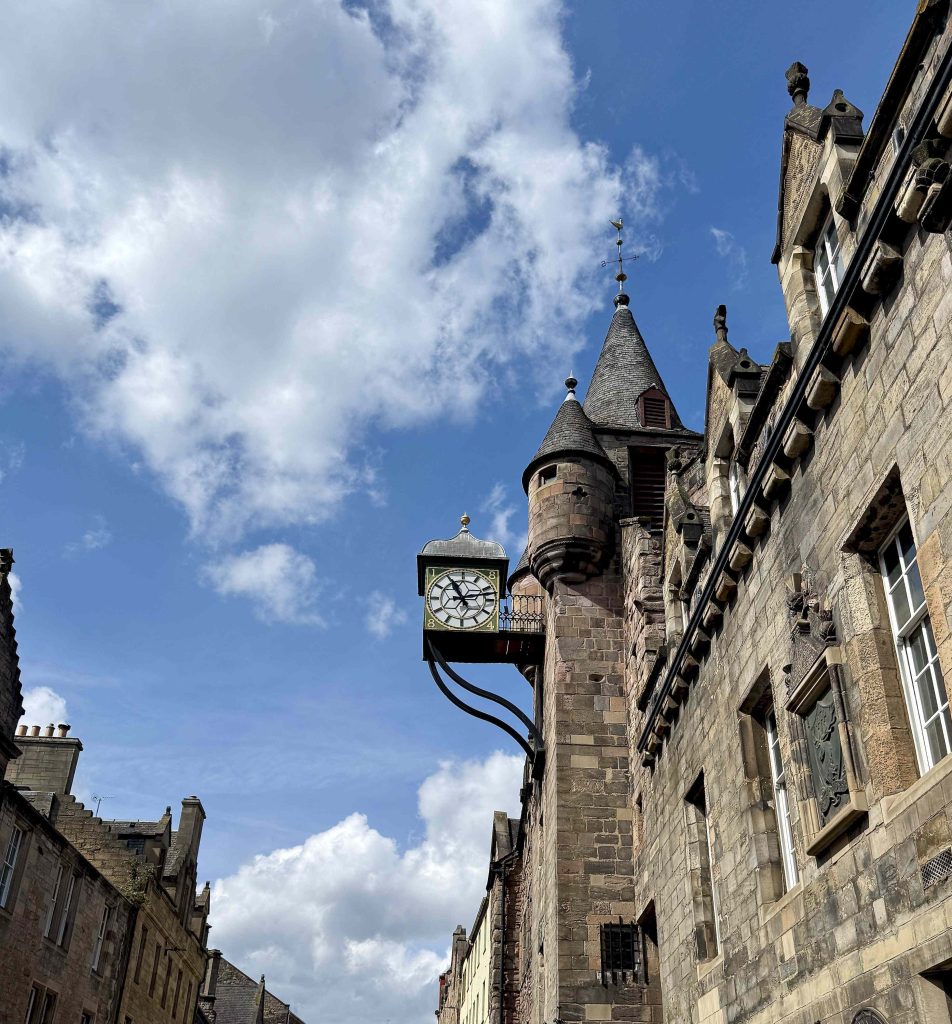
Royal Mile
Royal Mile

When I am feeling creative, ideas for characters, worlds, situations, and stories appear constantly. Inputs are everywhere: a great movie character, a strange news item, a walk around the block. But how long should a raw idea sit before it can turn into a story? In a perfect world, we would dream of a story at night and write it in the morning, like McCartney and Yesterday. But most ideas need time to germinate in the back of the mind.

George Saunders has talked about how “The Semplica Girl Diaries” stayed with him for fourteen years before it finally worked. He circled it for ages, constantly pruning until the real story emerged. His experience suggests that some ideas need a long stretch before they can be touched. Diane Cook describes taking notes on The New Wilderness for a few days, then shelving the idea for years. When she returned to it, the world of the book had settled enough for her to enter it fully.

I can relate to the slow-germination approach. Two stories in my upcoming collection After the Second Wave lived in my head for years before I wrote them. One involved a young boy on a landfill overhearing a conversation he cannot understand. Another followed a young man trying to reach the crypto paradise of West Palm Beach. The finished stories drifted far from the initial sketches, but at a high level they stayed true. Both ideas needed about two years before they found their way into something coherent.

So what happens during those two years? Pattern matching. The idea sits there, incomplete, like a puzzle missing a few essential pieces. Then one day another idea or event clicks into place and the pattern snaps into view. It feels sudden, but the mind has been searching for those missing pieces all along. In the case of ATSW, the missing piece was the family at the heart of it.

I am experiencing this now. I have wanted to write my own take on John Cheever’s The Swimmer for years but never saw “the hook”. Thanks to a recent life event, the elements I needed emerged. My mind had been running a quiet background process for a long time, waiting for the right puzzle piece.

Related Reading

Further reflections on how ideas, place, and continuity shape creative work.

The Geography of Daily Life: How Place Shapes Stories

Liminal Space
Liminal Space

I’ve written before about how mood affects reading, and how immersion influences writing. But what else shapes our stories? Emotions, the time of year, the room we write in. My unfinished novella was drafted in the early days of the Covid lockdown, and it carries all the tension and fear that hung in the air. How does my daily world find its way into my work?

I don’t write in a quiet New England hut or on a secluded island retreat. My days feature commutes, New York City, and suburban strip malls. Moments of grandeur tinged with decay. This isn’t neutral background noise, it conditions how I imagine fictional worlds. It shapes imagery, restlessness of characters, claustrophobia, the urge to escape, and a feeling that something is off beneath clean surfaces. No wonder I gravitate toward post-apocalyptic stories and settings.

The New Jersey suburbs carries a sense of the uncanny, an uneasiness buried beneath rows of similar houses and weedy lawns fed by gallons of clean water. The dreamlike monotony of sameness sits next to an awareness that all of it might be built on something rotten. Aging pipes, crumbling roads, dated schools, overstretched pensions, the illusion of safety and order. Is a post-apocalyptic world looming in the future, or is it already here, hidden beneath Dunkin’ Donuts plastic?

Commutes create liminal spaces. Ferries are a perfect example, suspended between home and the city, crossing water, physically and mentally in between. The subway is the opposite: nose to armpit with strangers, hot, held up by delays, engulfed by the steady decline of the system itself. Riders shutting down, wishing they were anywhere else in the world. These in-between spaces seep into my writing and create that drifting, epic quality. Characters become people who exist between worlds but never fully belong to any of them.

And then there is the streets of Manhattan. Everything all at once. Crowded streets, endless sirens, horns, the shouts of mentally ill. Sensory overload, followed by an instinct to retreat inward, to write inward, and search for quieter thoughts and clearer prose as a way to push back against the noise. I came up with the idea for my first story, The Inspector’s Legacy, while sitting on a bus outside the Port Authority in New York City, picturing the streets covered in ten feet of sea water.

So it’s no surprise I keep writing characters who bounce between solitude and entanglement. Characters who wrestle with the tension between isolation and connection, and never resolve it cleanly. Modern infrastructure becomes mythology. Ferries, highways, bridges, and subways turn into ancient runes. The built world becomes a relic. And in that relic I keep finding new stories.

Related Reading

Essays exploring environment, attention, and the conditions under which stories form.

Common Tropes in Post-Apocalyptic Stories

South Rim, Grand Canyon

Part 1 – Definition and Examination

When I first began writing, I was preoccupied with defining my genre. I never reached a definitive conclusion, but the process led me to study genre conventions more deeply—especially post-apocalyptic (PA) fiction, with its thematic clarity and recognizable structural patterns.

PA narratives often follow a familiar framework. There are foundational expectations, and beyond those, a set of recurring tropes that many stories employ—whether out of tradition or narrative necessity. Below is an examination of these patterns through a small, modern selection of works from both literature and film. This is not a “best of” list, but rather a personal frame of reference. With the exception of The Last of Us, these stories avoid zombies—an adjacent subgenre with its own distinct conventions.

Works considered:
The Road
Station Eleven
The Way
The Ancients
Children of Men
The Last of Us

(Note: I refer only to the film/TV adaptations of The Last of Us and Children of Men, not their original source material.)

Baseline Expectations
Every PA narrative begins after an identifiable collapse. This event—whether political, biological, environmental, or technological—marks a distinct rupture between past and present. In some stories, the collapse is explained in detail (The Way, The Last of Us); in others, it remains vague or entirely unspoken (The Road). Regardless, the precipitating event is the foundation upon which the genre is built.

A second baseline is the persistent presence of the old world—its remnants and ruins. Crumbling infrastructure, obsolete technology, scavenged literature, and decaying cities appear across nearly all PA stories. These elements serve as more than setting; they allow the narrative to reflect on the excesses, values, and failures of our current world. The contrast between what was and what remains creates a kind of cultural estrangement, often evoking both nostalgia and critique.

Together, these two components—collapse and relics—form the minimum narrative architecture of PA fiction.

Common Tropes
The Traveling Band
A commonly used device in the genre is the journey: a group of characters traveling through a devastated landscape toward a defined destination. This structure serves several purposes. It provides narrative momentum and allows characters to encounter the full range of post-collapse society—its dangers, its ruins, and its rare moments of order. It also echoes older narrative traditions: pilgrimages, wartime marches, and epic quests.

In most cases, the journey becomes a test of character and endurance. Through this movement, the story explores survival, morality, and shifting interpersonal dynamics.

Examples:
The Road, Station Eleven, The Way, The Last of Us, Children of Men

The Safe House
Closely linked to the journey is the Safe House: a temporary refuge offering physical safety and mental reprieve. These moments often mark a turning point in the story. They allow for recovery, reflection, and sometimes revelation. The characters regroup, reassess, and prepare to continue. Dramatically, these spaces slow the pace and offer interior depth. The bunker in The Road, for instance, represents a brief return to comfort—highlighting how rare such moments have become.

Examples:
The Road, The Way, Children of Men

The Cure
The Cure appears where the apocalypse is tied to disease or biological transformation. It is often literal—a vial, a person, or a set of instructions that must be protected or delivered. It serves as both a plot device and an ethical question: What does it mean to save a world that no longer resembles the one that was lost?

This trope frequently intersects with both the traveling band and the safe house, adding layers of urgency and reinforcing themes of sacrifice, hope, and preservation.

Examples:
The Way, The Last of Us, Children of Men

Related Reading

Reflections on genre, structure, and how familiar patterns shape narrative meaning.

Immersion, Continued: Attention and Presence in Fiction

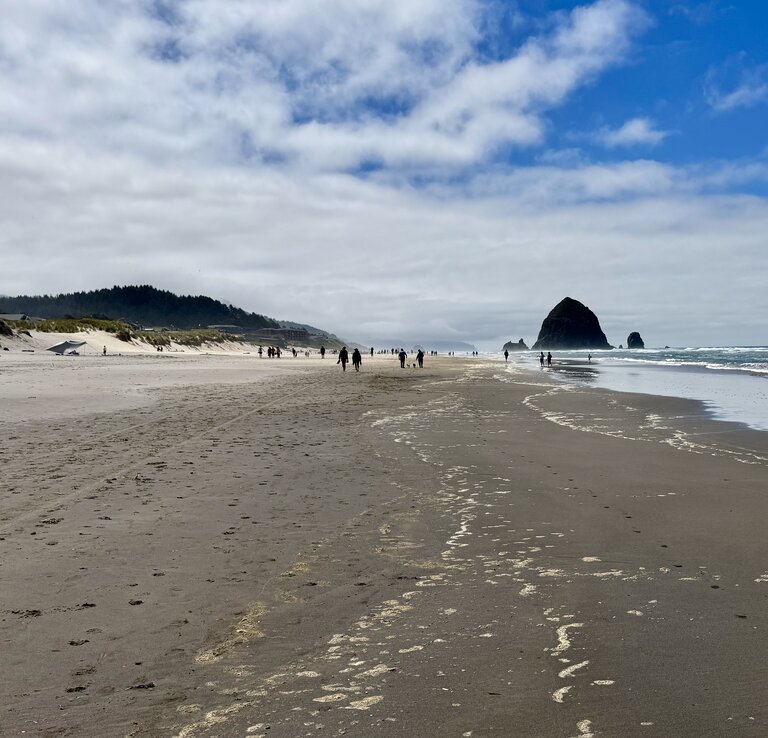
Canon Beach, OR
Canon Beach, OR

In Part 1, I described my current Irish jag. Earlier in the year, I did an immersion in Japanese books and streams (also unintentional). The Japanese list:

-Shogun

-Pachinko (Korean, but set largely in Japan)

-1Q84

-More Days at the Morisaki Bookshop

-Hard Boiled Wonderland and End of the World

-Tokyo Vice

Similar to the Irish immersion, the primary effect was a wish to visit Japan, a place I’ve never been. Crowded yet orderly Tokyo streets bathed in neon, misty shrines, long hikes up mountains and through prefectures, everything.

I am disoriented, though, after hearing and reading (translated) Japanese dialogue. While I love Murakami books I always found his dialogue strange. Like something out of bad 1950s movie. Lots of “Hey man,” or “… in a way of thinking”. This discussion on Reddit picks up examines the issue.

I know little regarding translation, but understand the translator matters. The odd or flat dialogue may be translator choices or the inherent difficulty in porting Japanese dialogue. This dialogue is evident in most Murakami novels (with different translators) as well as stories from Kazuo Ishiguro. The strangeness of the dialogue is magnified when compared to spoken Japanese in any of the above listed shows and movies. Japanese is lyrical, full of inflections, and a beautiful listen. The flatness must come from the translation.

The lack of translation from Irish literature (excluding any written in Irish) lets Irish dialogue jump off the page. I can hear and revel in the lyricism. As a native English speaker, the same doesn’t happen with written Japanese dialogue. Hearing it makes the gap feel wider.

Related Reading

Additional essays on focus, continuity, and the experience of sustained reading.

Talking Immersion: What Writers Mean When They Talk About Immersion

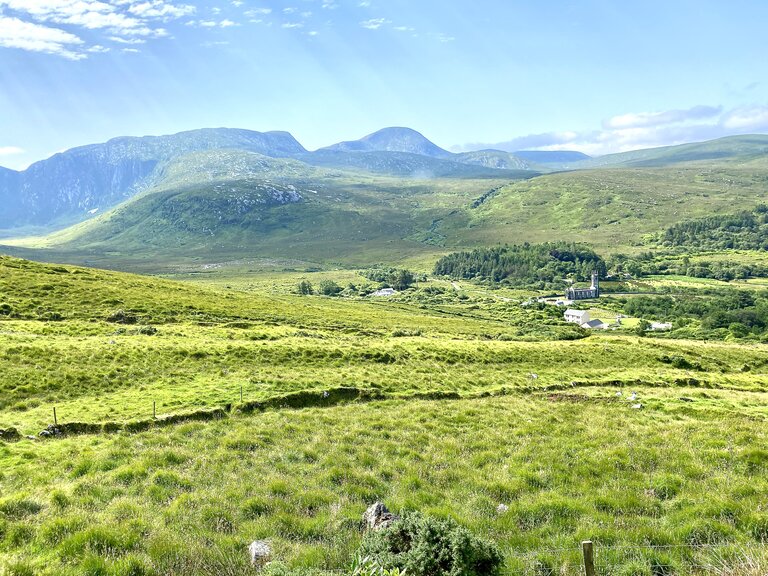
Donegal
Donegal

The best way to learn is to immerse yourself in a subject. Tyler describes a deep reading process. I’ve followed this path over the past few months in a deep Irish “content” jag. I’ve either read or watched

The primary effect of this immersion is a desire to hole up in a cottage in Donegal with my iPad, printer, and notepads and churn out great literature. Soak in the landscapes and split G’s every night at the local pub.

On a more practical level, I notice the lyricism in dialogue. Not Shakespearean iambic pentameter or Mamet’s famed dialogue, but an Irish way of speaking. Even my flat ear can hear the music jump off the page with wonderful jumps and inflections. The dialogue sings in my head.

Sadly, this hasn’t touched my writing. Too many years of living in NJ with our fast-paced, rhotic speech pattern. A lengthy corporate career. My dialogue is realistic but not interesting. Maybe I need a cottage. Or a Guinness.

Related Reading

More thoughts on attention, presence, and how readers engage with stories.

Breaking the Unbreakable

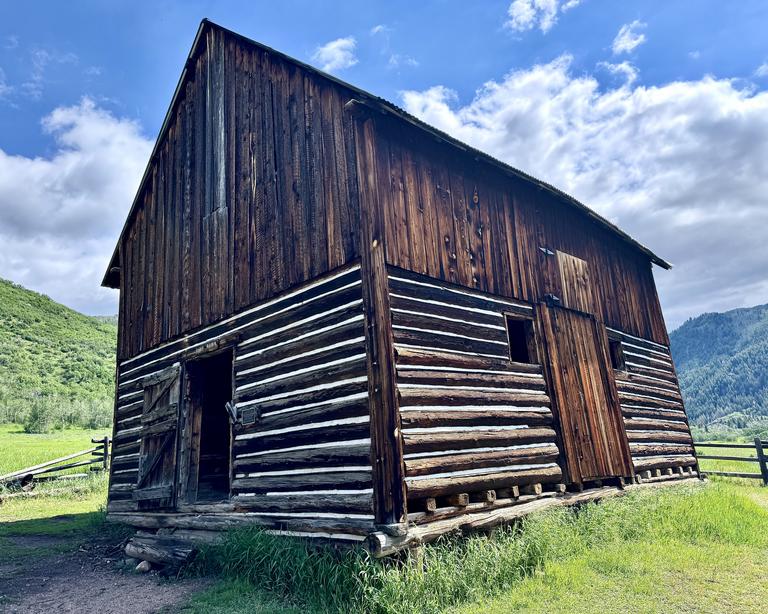
Colorado Cabin
Colorado Cabin

I began writing fiction during the pandemic. Without travel, gym trips, or work commutes, mornings were the same. I established my morning writing routine; 500 new words per day wedged in between Morning Pages, meditation and a bike or run.

I carried this routine into the immediate post-pandemic world, featuring brief trips in hotels for soccer tournaments, occasional commutes, etc. I wondered if changing the routine but keeping the commitment would unlock creativity (no!). Fast forward to now; as work and life speeds up past it’s previous velocities, the unbreakable daily commitment faltered.

Writing is harder now. Specifically, it is challenging to find the right time and mindset. I still carve out at least 30 minutes for “writing” each morning, but under the pressure of making the ferry and a full day of potential work issues… the needed focus isn’t there. Often I skip writing these mornings.

Writing while away is also hard. Once I broke this unbreakable promise to myself, writing while on vacation with family or friends became an impossible obstacle. And I can only beat myself up so much about it… what’s more important in the long run, scribbling down dialogue between two imaginary people or playing with my niece?

But I feel empty or guilty every day I don’t write. The original mandate to write everyday mandate came from Tyler Cowen. Granted, Tyler writes non-fiction, but is prolific and so good. The other voice scolding me is Julia Cameron, who I leaned on when I started. Hard to argue against keeping the muscle very active and tuned and supplying a large supply of material.

I used to think I needed a mythical writer’s getaway; alone in a cabin in the woods with nothing to do but write for weeks on end. Now I know better. I’d benefit from a routine allowing a couple hours of daily writing and follow-up time (editing, seeking feedback, blog writing) for a handful of hours each week.

Through-Lines: What Holds Stories Together

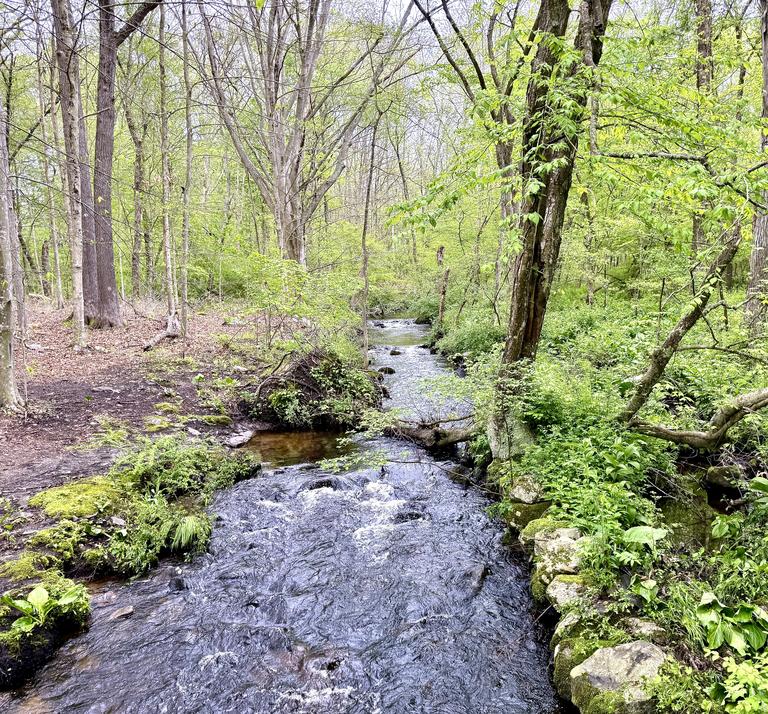
Conn River
Conn River

I’ve often referenced After the Second Wave, an in-progress collection of post-apocalyptic short stories. The project is moving along, albeit slowly with a writing coach and editor. Progress is slow because my original versions of these stories weren’t very good. The feedback process, combined with a full workload and family, takes time.

I’m not only getting feedback on the individual stories. Not only am I getting feedback on the individual stories, but I am also being challenged to consider how the collection should present as an overall piece. I’ve thought of it as a bunch of stories held together by a common world and common characters, with callbacks and references. But there should be more; the collection needs a through-line. There is a loose through-line as a function of the genre. Any post-apocalyptic story is about our modern world and how we’re destroying it, the true nature of man when confronted with a new world, overcoming hardships, etc.

Ghostwritten by David Mitchell is my guiding light on this project. In his first novel, he assembled a collection of seemingly independent stories interrelated by characters and the world. The stories hang together loosely on first read; each subsequent read reveals tighter and tighter cause and effect. Any reference to an event or character outside of the current story is invariably a callback or reference. But I can’t find a through-line. The last two stories directly reference the Iraq war and an almost global nuclear war controlled by an out-of-control AI (developed by a character from a previous story, of course).

There are a cluster of themes within Ghostwritten; stories about love and isolation and overcoming. And I need to consider the same; readers need a sense of an arc. The initial stories could focus on the shock of a new word, causing pain and suffering. Then, the middle stories reflect change to the new world. The final set could offer a glimpse into successfully, or unsuccessfully, overcoming obstacles and finding a better way.

It’s helpful to consider through lines after most of the stories have first drafts. Much the same way, applying the classic story structures is more effective after the first draft. Starting with a story structure first or set of themes would hinder the natural progression and feel forced (more on this in a future post). Now is the time for me to see the through-line.

Related Reading

Essays on continuity, structure, and how meaning accumulates over time.

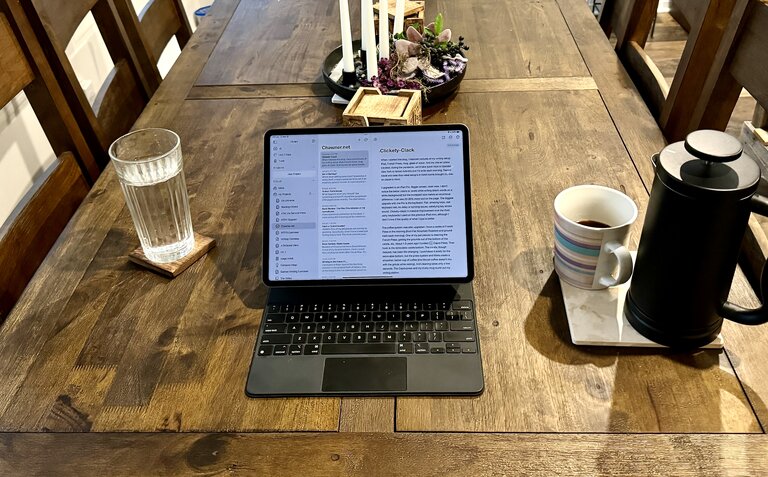
Clickety-Clack

Clickety Desk
Clickety Desk

When I started this blog, I featured pictures of my writing setup. iPad, French Press, mug, glass of water. And my mis-en-place traveled; during the pandemic, we’d take quick trips to Upstate New York in rented Airbnb’s and I’d write each morning. Recent travel with less-than-ideal setup’s in hotel rooms brought my mis-en-place to mind.

I upgraded to an iPad Pro. Bigger screen, nicer view. I don’t notice the better colors or pixels while writing (black words on a white background) but the increased size makes an enormous difference. I can see 20-30% more text on the page. The biggest upgrade with the Pro is the keyboard. Flat, amazing keys, real keyboard feel, no delay or syncing issues, satisfying key stroke sound. Clickety-clack! A massive improvement over the third-party keyboards I used on the previous iPad mini, although I don’t know if the quality of what I type is better.

The coffee system was also upgraded. I love a carafe of French Press in the morning (from Fair Mountain Roasters and ground fresh each morning). One of my pet peeves is cleaning the French Press; getting the grounds out of the bottom of the carafe, etc. About 1.5 years ago I funded Capra Press. Their hook is the removable carafe bottom. The carafe, though delayed, has been life-changing. I purchased it solely for the removable bottom, but the press system and filters create a smoother, tastier cup of coffee (the filtered coffee doesn’t mix with the grinds while resting). And cleaning takes only a few seconds. The Capra press and my trusty mug round out my writing station.

Other items come include books I’m using for inspiration. At the advice of my writing coach, “Room” by Emma Donahue is within arm’s reach. I copied passages from her to work on my child-point-of-view story.

I don’t want to be too precious about my setup. Best to be flexible. A craftsperson needs to know and love their tools.

Something Old, Something New

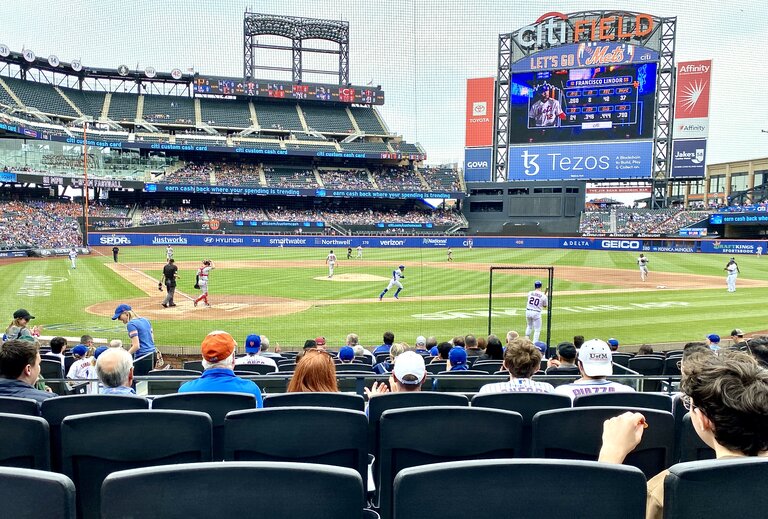
Citi Field, May 2022

I re-told a classic story in the “After the Second Wave” world. The original is from Edgar Allan Poe, The Cask of Amontillado. Poe’s narrator lures an enemy into his family catacombs under the guise of inspecting a cask of Amontillado. Once in the catacombs, slightly drunk and coughing badly because of nitrates, the enemy is chained to a wall and entombed while still alive. The tale is spun by a cold, manipulative, and unreliable narrator… very Poe.

Writing a version of this tale in my world was interesting. As written, the story stays true to the original plot. And writing it was… easy? Fun? I didn’t have to spend cycles worrying about what should happen.

Poe’s style bled into my writing. He was from a different era, with a flair for the dramatic, a love of exclamation points and adjectives. In trying to emulate the feel of his narrator, an unstable man who committed a terrible act years ago, I wrote like Poe. It felt natural.. and one character is quite pompous, so this style befits his speech.

After completing a first version of this retelling, I’m worried it’s not interesting enough… and is just a copy, not a re-interpretation. Sure, the details are different, with new characters in a post-apocalyptic future (opposed to the nineteenth-century Italian setting of the original). But it doesn’t have any deviation from the original plot. Does it need… a different, more shocking outcome? When a story is “re-imagined”, how many does it need to deviate to be a unique work?

Often, when a story is said to be re-imagined, it’s just swapping the gender of characters, or setting the story in a different time and place. What is the dividing line… can updated details make the story new, or does the plot and ending have to differ as well?

In the end, I want to revisit this piece after a few weeks or months. I’ll pick up the story new and edit with fresh eyes, rather than trying to match how Poe set up his story.

WASTED CRISIS

by Daniel Chawner

Download .epub file

Megs tried not to throw up on her keyboard, zero-early o’clock on Labor Day weekend, the morning after Margarita Madness. She swallowed hard and tried to focus. Her logins weren’t working, not the regular account, not the super-all-powerful admin account, nor the test accounts. She couldn’t get into the company’s main app.

Bobby, from over her shoulder, said, “See? See? We’re totally screwed. How did this happen?” He pounded the desk, sending Megs keyboard flying.

“Bobby, calm down. Now that I’m here, walk me through it again. You weren’t making sense on the phone.” Bobby had sounded hysterical, said she needed to come to work right now, and it didn’t matter she was at her friend’s lake house, two hours away. Hung over.

“It’s like I told you, I got this weird email. Then I tried to get onto our app and couldn’t.”

“Show me the mail.”

“I’ll send it to you.”

“No,” said Megs. “Let’s assume your emails are toxic.” More toxic than usual. “Show it to me, on your phone.”

Bobby thrust his oversized iPhone in Meg’s face. She pushed it away until the text came into focus and read it twice to comprehend the broken English.

“Robert Ugnaught, You have been pwned. App at Ugnaught Construction and Engineering are mine. Follow instruction below to buy and transfer $100,000 Bitcoin. You get 48 hours. Or delete everything.” Below the text were step-by-step instructions for buying Bitcoin.

“How did they do this? How did they get into UFA? I thought you and Ravi had locked everything up.”

“We secured what we could, but you wouldn’t let us lock down our system, remember? I wanted to buy those tools and restrict access to non-work-related sites?” Bobby loved to spend his afternoons on SnapChat, Among Us and other non-work sites.

“So is there something we can buy now?”

“No.” Megs rubbed her temples. Explaining technology to Bobby, the youngest brother of the family business, was hard under normal conditions. Talking to him through a pounding headache and dry mouth seemed impossible. “It’s too late. We should contact the FBI, or a firm that specializes in emergencies like this.”

Bobby stopped pacing and leaned on Meg’s desk. “We can’t let this get out. I mean, if we talk to the FBI or whoever, it will be public. And it will take too long to hire someone else, right? We basically have two days; we need everything perfect for Tuesday morning.”

“Or you could, you know, pay them and hope this all goes away.”

“I’m not paying ransom to a bunch of Russian kids. No way. And besides,” he said in a lower voice, “I don’t have that kind of money.”

Outside the window of their suburban office, Bobby’s Model S blocked the fire lane. In his reserved spot was his other car, a fully loaded Cadillac SUV. Bobby’s house, which Megs was forced to visit every Fourth of July for the big company party, was at least 5,000 square feet and had two pools.

“You hide it very well,” she said.

“What’s that?”

“Bobby, they aren’t looking for you to pay, right? It’s the company that got hacked, not you personally.” As long as we ignore you’re in charge of technology and security, and fired the CIO for disagreeing with you last year and never replaced him. “We should call Brad.”

“Listen,” Bobby said, “I think this is best if we just keep this between us. Don’t involve my brother. So, what do we do now?”

“Coffee. Why don’t you get me some? In the meantime, I’ll call Ravi and see if he has any ideas.”

“You think you can get him?”

“I don’t think they celebrate Labor Day in Bangalore. So, yea. Make it large with a splash of cream.”

Bobby raised his eyebrow. This may be the first time anyone asked him to run an errand.

“By the time you get back, I’ll have some ideas. Go, there’s a Starbucks a few minutes away.”

“Yeah, I could use some coffee. Be right back,” he said and pushed through the heavy door separating IT from the rest of the office.

The caffeine would help but getting Bobby out of her hair would help more. Ugnaught Construction and Engineering had moved their most critical app, Ugnaught Field App (UFA) to the cloud, servers that someone else owned and maintained. It let them lower costs and move faster. It also meant if their accounts didn’t work, they couldn’t use their cloud-based app and data. The entire firm, field engineers, back office, and the CEO, needed UFA to do their jobs. Megs tried her logins again, just to do something. Same result.

Megs felt helpless; she usually solved problems and kept the app running. Now some hacker from thousands of miles away was threatening their company and potentially their livelihood. Did they target Ugnaught, or cast a wide net? Did the hacker need money to pay bills and feed a family? Was it worth ruining our weekend, our career, our lives over this? When she was with Microsoft entire teams stood ready to handle this type of crisis. Here, we didn’t even have a CIO or proper network engineer. These hackers had Ugnaught’s fate in their hands. Megs clenched her fists, then called Ravi.

“Hey Ravi, do you have a few minutes?”

“Hi Megs, thought you guys were off this weekend.”

“We were supposed to be.” Megs filled him in on the details.

“I just tried my credentials as well. No luck. Do we know how this happened?” said Ravi, polite and helpful as always.

“Could be phishing, or we left something open on a server and they found it during a scan, or one of the software—”

“It’s almost always phishing, someone clicking on a malicious link, right? I can run a scan on emails from the last week or so and see if there are any likely sources. Luckily for us, we still have our network and email local, not in the cloud.”

“Will a scan help?”

“At least we’ll know how the hackers got in,” said Ravi.

“Alright, let me know.”

Megs stood, stretched, and shuffled over to a blank whiteboard. If they couldn’t get into their system and Bobby wouldn’t pay, they needed to rebuild. From scratch.

She wrote “Source Control”, “Data”, and “Backups” across the top of the whiteboard. The best choice is the backups, copies of their entire server made on regular intervals. Megs hurriedly re-dialed Ravi.

“Ravi, my mind is mush this morning. We didn’t talk about the backups.”

Silence.

“Ravi, did you hear me?”

“Yes, I heard you. Do you remember where we put the backups?”

Oh shit. “We back them up to the same servers, don’t we?”

“Yeah. We can’t get to the backups either. We intended to fix it over the summer, but…”

But there were issues over the summer. Instead of working on the backlog of work projects, like backups, cleaning up directories, auditing accounts and killing old, legacy jobs, she spent most of July and August with Mom and Dad. Megs had moved back to New Jersey from Seattle five years ago and gave up a nice career at Microsoft; she was on a Managing Partner track. But the weekly phone calls with Mom became more strained, and Rodger, her brother, cracked under the stress. So, she left the fast-paced world of high-tech and became a jack-of-all trades, part sysadmin, part programmer for a mid-sized, family-run firm.

In July, Rodger announced he couldn’t handle the daily visits to Mom and Dad anymore and was broke. Two days later, he and his family moved to Philadelphia, leaving Megs to buy supplies, drive to doctors, pick up medicine and arrange nurse visits. After two weeks of continual care, Megs found a local nursing home. Which solved one problem and created another: a $15,000 per month bill, payable in advance. In cash.

“Oh crap. But we have the off-site tape backups, where we write all the database information to a tape and mail it somewhere secure.”

“Let me check,” said Ravi, followed by the sound of typing on his keyboard. “Yes, but we only do full backups to tape once a month. On the fifteenth.”

“So, we didn’t lose everything, then. How soon can we get the tape sent here?”

More typing. “Thursday. Assuming they pull the tapes and mail them Tuesday morning.”

That’s better than nothing; that’s most of the data. “But the source code, that’s in a separate place. In GitHub, a different cloud system.”

“Yes,” Ravi said, “that’s true. But we do our builds, where we assemble and deploy the source code, on the main server.”

“So? That doesn’t change the… oh. We store our logins to GitHub there, don’t we?”

“Yup. In—”

“In clear text. Not encrypted, which was another thing on the summer list. If these hackers looked in there…”

“They could get to the source code and lock us out. Or wipe it. Or both,” said Ravi.

Megs jumped back in her seat and opened GitHub, furiously entered her login and password and held her breath while the icon spun. Then she exhaled; their source code was still there, filed neatly in branches. “I’m in Ravi, it’s all here.”

“Change your password, now. And disable the account that does the build.”

“Yep. You should login and do the same,” said Megs, smiling for the first time this morning.

“I may have found the phishing email,” said Ravi. “I’ll let you know when I’m sure.”

Megs leaned back in her chair. Like the tapes, something else tickled the back of her brain. Maybe closing her eyes would help.

The bang from the IT door jolted Megs out of her nap. Luckily, she fell asleep upright up in her chair, not face down on her keyboard.

“Here you go. Any luck?” said Bobby. He placed a large white paper coffee cup on her desk, light brown liquid escaping from the cap and rolling down the side.

“Ravi and I are working on it. Good news is we still have access to the source code.”

Bobby smiled. “We’re good, then? I meant to tell you, our app on my phone is fine.”

“They can’t lock that down. But, if you tried to connect to the server, you wouldn’t be able to. Remember how we have that set up?”

“Yeah, to let the engineers work offline. So, they have their own little databases on their devices.”

“That’s right. And, if they didn’t update anything, they could work for a day or two.”

“We could have some more time to repair this?”

“Kinda, it only solves the engineer part. The rest of the company, the execs, accounting, they all login to the portal which is on the cloud.”

“If I told Brad we were doing maintenance, and it went long, but the techs could still work… and we got it fixed by like Wednesday… then maybe they wouldn’t have to know.”

“Only if you hid the truth from them.” Megs shouldn’t have been so blunt. The best way to deal with this man-child was to nudge him in her chosen direction. She hastily added, “We can build the software, err, apps again. And set them up on a new server. But they won’t have any data. For that, we’d need to instruct all the engineers to upload their field data to the server and set up some rules for putting that stuff back in the database. If we get lucky, maybe we could restore half of the data. At least the most recent stuff. And then get the tape back by Thursday.”

“So that doesn’t help us at all. Shit.”

“It helps a little, it—”

“When the company comes into work Tuesday, when the engineers fire up their apps, when Brad sits his ass down at his desk and tries to pull up the monthly numbers, will any of that work?”

“The apps would be there, but no data.”

“So, they won’t work. Useless. I thought we had something in place to get backups. I see them on our monthly bills.”

“They got them, too.” No need to explain why they got them, at least not yet.

“Dammit,” said Bobby, flopping into a chair around the small conference table in the center of the room. “What else?”

“Ravi thinks he knows how they got in. He’ll let me know soon.”

Bobby pulled out his phone, slurped his mocha-colored iced drink through a straw, and turned away from Megs. Great, he’s going to stay.

“Are you sure we can’t call Brad and talk to him? Maybe he can negotiate with these guys?”

Bobby flinched at the mention of his older brother’s name. “No.”

“But we may not —”.

“No, we can’t let Brad or anyone else know. In fact, send out an email letting people know you took the system down for maintenance and they can’t access it today. In case some eager beaver logs in on their day off. Like Brad.”

An instant message from Ravi flashed on Megs screen.

Found out how they got it. Bobby clicked a fake FedEx link, and they got his admin credentials. Keyboard logger.

Megs opened her mouth to tell Bobby, then stopped. He was quiet. Better to keep him that way.

Great. Any other ideas?

No, will keep looking

Let me know, thanks.

What were the remaining options? Pay and get everything back. Maybe. Don’t pay and rebuild the system from scratch on the sly. Or come out with the truth and restore the apps with the company’s help.

Coming clean and telling Brad, CEO of the firm, made sense. He was an engineer; he’d see this for what it was, a puzzle.

“Bobby, this is where we are: we can rebuild the code. Probably take most of the day, but we could get the app stood up pretty quickly. We need to tell the users to connect to a different server… which isn’t hard.”

Bobby stared at Megs, expressionless. His hair looked matted, his eyes bloodshot and face puffy. Puffier than usual.

“And then we need to tell them to go into the settings of the app and do a one-way, err, push all the data they have to the new, empty database. Ravi and I could write some rules for what data to keep, what is most recent, that kinda stuff. But it won’t be 100%, and it may take us a few days to get the data straight. By then, we should have the tape backup. As long as it’s okay, we can piece together most of the data, probably with a few gaps from last month.”

“How long?”

“For which part?”

“Until everything is back to normal.”

“If everything goes like it should, and all the engineers followed the instructions… Friday, or early the following week?”

Bobby hung his head. “Not good enough. If I have to tell Brad about this… he’ll ask a lot of questions. And we’ll be screwed.”

“He might just choose to—”

“No chance. He’d rather shut down the company then pay a hacker. You know what he did the last time something like this happened? When a few computers and printers went missing a few years ago?”

“Faintly.”

“He ran a full investigation that cost more than the missing equipment. Questioned people for hours, put together a report, hired someone to help him. And got deep into everyone’s business. It was awful. Cost me a bonus that year also, ‘cus I run the office team as well as IT”

Megs stomach lurched again. Brad was intimidating; if he questioned how this happened, they’d have to tell him about the shitty backup plan.

“What else have you got?” asked Bobby.

“Right now, nothing,” said Megs.

He slammed his open palm on the table, rocking his latte. “Useless, you are useless. There has to be another way to fix this.”

“I’ll keep looking,” muttered Megs. She focused her attention on her monitor and randomly moused through her open windows. And tried not to shake.

This was Bobby’s fault. He clicked on the link and forced them to keep the system open. She could make Brad understand. But not having backups available was on her. Could she hide it? Brad, while analytical and fair, wouldn’t hesitate to fire someone over this. And he couldn’t fire his brother. Working at UCE wasn’t perfect, but the pay was alright and the hours, for IT, pretty manageable. And there weren’t a lot of other places she could work and still be near her parents. Megs now felt doubly trapped, by Ugnaught and these hackers.

Megs clicked on the window with the source code. Nothing new there. Clicked on the window with UFA. Her password still didn’t work. The only other system she had access to was email. Megs clicked on her inbox, her deleted mail, then on the separate folders she had in her inbox for something to do. Or at least to look like she was doing something. Out of the corner of her eye, she saw Bobby drop his head into his hands.

One of Megs’ folders had 700 unread mails, named LegacyJobs. Great, another reminder of the work we didn’t do this summer. She clicked in the folder and gasped. There it was: “FullDBJob09032020-Complete”, the answer to her hung-over prayers, the thing tickling at the back of her skull. One of the legacy items, a job she set up when they first moved their data to the cloud, took a full backup of their database, compressed it, and sent it to their old server. The old server, the thing running in the almost-empty closet next to her desk. Here, all morning. The company’s data backed up as of two days ago sitting on a piece of hardware she meant to turn off weeks ago.

They could stand up a server in a few hours, quickly restore the database, and have a busy Tuesday morning tackling minor items. No one at the firm had to know. Bobby would get off scot-free again.

Megs sat up straighter in her chair. The buzzing headache receded and she felt whole, strong. They were going to get out of this mess. Or, at least, she was. Now Megs held the fate of the app, Bobby’s career and the health of the company in her hands. No one else knew about this legacy backup, not even Ravi.

If the hackers were going to extract a pound of flesh, why not Megs? The nursing home bills would ruin her finances for years, maybe for the rest of her life. But not if someone else picked up the tab. An extra $15k a month would change her life, for the better.

“Hey Bobby, we know how the hackers got in.”

Bobby raised his head out of his hands and looked over at Megs.

“You clicked on a bogus FedEx link, and they stole your password. You handed them the keys.”

Bobby, who was pale already, looked deathly as blood rushed out of his face. “I, uh, how…shit.”

“And they really got us. Too bad we didn’t have a CIO anymore to pin in on, eh?”

Bobby squinted at Megs.

“Maybe someone like that could get us out of this jam. And would have forced us to buy the right tools, earlier, and get serious about blocking phishing links. Probably pretty pricey, though.”

“What good does that do us? Oh my God, I’m so screwed. We’re all screwed.”

“Yea,” said Megs. She paused to pick her words carefully. Days later, while she admired her new office and nameplate, she’d wonder if the conviction of her next line came from deep inside or that fourth margarita.